
Every so often, I see some encouraging signs in business. I have been reading about a new day spa that has opened in Selma. Also in our own town, Foodies at Heart has been open for a little over a month and has seen some good success in its opening days, as well as some positive news coverage. I have had the pleasure of dining there with my family for breakfast, lunch, and dinner, as well as to grab an occasional cup of coffee. Keith’s Cookin’ on Ricks Road has picked up the mantle of the town’s barbecue restaurant and has made a great effort at customer service and quality. My family has been eating out most every day as of late because our kitchen has been torn apart for remodeling for several weeks now.
On the flip side, I have run across a bad experience in the search for another automobile. We actually own a second car, but my mother-in-law has borrowed that vehicle and we are most likely never going to see it returned. I have often wondered why she doesn’t just buy a new broom and ride it instead of borrowing our car, but she is family and we love her. Yeah, I love mother-in-law jokes and she knows that I love her dearly.
I had searched for a car online at several automobile sales web sites and found one or two cars at one particular local, independent used car dealership. I checked out the car I had in mind. It seemed to be in good shape. It looked nice, was clean, and was about what we wanted for a second car that would be seldom used. Considering our family needs and our upcoming activities, it seemed a perfect fit. But I wanted to do my homework before buying.
I checked the three major web sites that offer used vehicle appraisals and retail values. All looked good. I then took the vehicle to my mechanic, and I am glad that I did. The car, though the dealer claimed that it had a clear title and collision history, was obviously damaged from a wreck. Either the dealer was hiding something or the vehicle history report was lacking in details. My mechanic showed me a broken bumper held on by duct tape and bungee cords, frame damage, leaking freon in the air conditioner, and several other things unseen at first glance. My mechanic saved me from a costly mistake.
I compare that to two dealerships I have also visited. Both had an eager to help manager who was very accommodating. Both had at least one vehicle that really interested me. One had a cheaper car that was probably a good deal, and although I liked the sedan, it was probably something less than first choice. The other dealership had four cars of interest to me, one of which we may end up purchasing. The manager there was friendly, up front, and encouraged me to take the vehicle to my mechanic for an inspection prior to purchase and offered a 30 day guarantee on his vehicles.
When I was contemplating a used vehicle, I had figured that I might find a decent, perhaps older vehicle that would suit my needs. Do you know what hindered that concept? It was the Cash for Clunkers program by the federal government about 18 months ago. Cars that were otherwise in good shape had to be destroyed instead of making their way back onto car lots for resale. In talking to car lot owners, Cash for Clunkers was a boon to new car dealerships but generally hurt the used car dealers. Many used cars I found were much newer and more expensive than I wanted to pay. The “new to me” vehicle I am probably going to drive home this week is almost $5000 than I really wanted to pay. Then again, I wanted a quality family vehicle with plenty of cargo space. Instead of a mini-van like I had imagined, I am most likely getting one of those evil SUVs that are causing global warming. OK there is no global warming, and especially none caused by mankind.
There is something to be said for keeping government out of the business world and good old fashioned customer service by business owners. Good service has kept us going back to a few local restaurants and has possibly made a customer out of me for an automobile purchase.
Showing posts with label business. Show all posts
Showing posts with label business. Show all posts
Wednesday, March 30, 2011


Wednesday, September 29, 2010
Column for Sept. 30, 2010
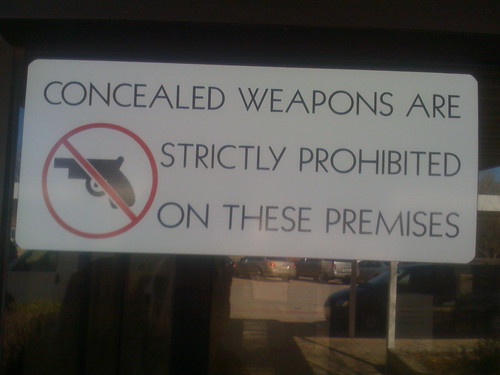 I recently sent a letter to the largest toy centered business in the world. I am not going to mention the name of the company, but I will share the letter with you.
"Just when I was about to continue my practice of getting my Christmas shopping done early for two boys and a bunch of nephews and nieces, I read that your company has unfortunately decided to disallow concealed carrying of firearms in your stores by law abiding customers like myself. It is not the law abiding citizen who has at his own expense taken classes on firearms law and handling, not to mention gone through an extensive background check by state law enforcement and local sheriffs that you have to worry about. You have to worry about the lawless, which steal weapons and use them to suit their own illegal practices. If there is ever a deranged or criminal shooter in one of your stores, it is people like me who you want to have as patrons in your stores to protect your customers and your employees.
"I make it a practice to not patronize businesses that wish to abridge the freedoms of honest Americans but still want our money. In America I not only have the right to carry a firearm to defend myself and those around me, I have the freedom to spend my money where I so choose. As long as your "no concealed weapons" policy is in effect, I shall choose to spend my money with your competitors."
Do you know why there are a lot of carjackings perpetrated near airports? It is because criminals know that anyone who just stepped off an airplane and is renting an automobile is unarmed because of security restrictions for air travel. That makes them an easy target.
Do you know what tells me that a business is an easy target for armed robbery? It is a sign on the front door that says something like, "All weapons prohibited", or "Concealed weapons prohibited". It announces that there is a good likelihood that there is nobody inside the business that is armed and can fight back. Then again, a house in an affluent neighborhood with a car in the driveway displaying a pro-Obama bumper sticker serves the same purpose to a burglar.
If schools allowed safe, concealed carry of firearms by trained, mature individuals, perhaps the shootings in Paducah, Columbine, and at Virginia Tech would not have been so deadly. Just maybe someone could have taken out the shooters before they killed more people. Police can not be everywhere all the time.
The State of New York proposed an amendment to the US Constitution for the Bill of Rights that explained the role of an armed populace. Their proposal included "That the People have a right to keep and bear Arms; that a well regulated Militia, including the body of the People capable of bearing Arms, is the proper, natural and safe defense of a free State". The responsibility was that of the citizenry to serve as the militia as well as to act as a constabulary force. The idea of a standing army was anathema to them, so it was expected that every able bodied man who could bear arms would be a participant in the putting down of insurrections, helping to repel invasion, and keeping order in their towns.
When I was asked why I would want to carry a gun, my answer was, "Because a cop is too heavy to carry around." I am a concealed carry permit holder. That means that I have demonstrated proficiency with a handgun, I have taken a class to learn the legal responsibilities of carrying a firearm, and have undergone a full background check by the State Bureau of Investigations. My fingerprints are on file with the state. In my own case, I have also undergone a background check by the Federal Bureau of Alcohol, Tobacco, Firearms, and Explosives because I also hold a Curio and Relics federal firearms license.
There are millions of people like myself who are law abiding, honest citizens. These are not the people you have to worry about. They are not criminals. They are the ones who have jumped through hoops of unconstitutional red tape in order to exercise their rights. Constitutionally, nobody should be required to get a permit to carry a firearm.
Business owners have every right to restrict what people should be allowed to carry into their establishments. At the same time, they are exercising their right to alienate their customer base and advertise themselves as easy targets for armed robbery.
Now compare the above to this business in the video below. I would do business with them in a minute.
Wednesday, December 23, 2009
Column for Dec. 24, 2009
Last week, I was in a bit of a rush to ship a package by a deadline. On the way towards Durham, I wanted to ship out a small box to a business half way across the country. Since I have shipped literally thousands of packages over the years (I used to own a business in which I shipped packages to customers all over the world) I figured it would be no big deal to get one into the postal system.
I remembered that the Selma Post Office opened around 8:30 AM. One time I tried going earlier and found that they opened up then. So I grabbed the list of errands I had to perform which also included stopping by my bank and grabbing a freshly brewed Dunkin' Donuts coffee after I hit the Post Office, and headed out the door.
When I got to the local Post Office, I found a small line forming in front of the interior door at around 8:45. It seems that even in the holiday season, and especially the week before Christmas, the Post Office had changed its opening hour to 9 AM. I was not about to wait for another 15 minutes, so I hit the bank, the coffee shop, and went on to the Post Office in the next town. I figured that Smithfield was a bigger town and for sure their Post Office was open already. Negative. Their Post Office opened even later. I saw several upset potential customers walking away with the same disgust I was feeling. Surely Clayton's Post Office would be open, and since it was generally along my way to my destination for the day, I headed there.
After walking away from the Clayton facility with my package still in hand, I answered the inquiries of fellow customers that the facility was not opening until 10 AM. I should have known from watching a young mother departing with a toddler in one hand and a package in the other that the Post Office was closed upon my arrival.
I traveled further into Clayton to a facility I thought for sure would be open. A very large shipping company that delivers worldwide has a franchised agent store in Clayton. I am not going to mention the business name, but its initials are UPS. Bingo, they were open. Score one for private industry.
Private industry will only flourish however, when it meets customer needs at a price customers are willing to pay. I was astonished as I watched two extremely unsatisfied customers storm out of the business without transacting any business. One simply wanted to leave a dollar on the counter for the busy clerks to ring up later for a small card worth far less than a dollar. He was rebuffed so he dropped the card on the counter, made a deserved sarcastic remark to the clerk, and left.
One lady in front of me was quoted a price for shipping a large, gift wrapped, framed picture of some sort and a book. She was quoted over thirty dollars and we both winced. Then she was quoted an extra twelve plus dollars for the actual shipping. It seemed that the original figure was just for packaging the items for shipping and did not include freight charges. The customer got angry, felt misled, grabbed her items, and left. The two clerks shrugged off a second irate customer.
Then it was my turn to get annoyed. An item that costs about six dollars packed in a small box would cost over seven dollars to ship. Since I was not willing to go out of my way for a fourth time and find yet another Post Office, I paid the higher than expected shipping charge and left. At least I got tracking information for the package unlike I would have gotten at the Post Office and it shows that as of this writing, my package is on time for an expected delivery.
Here is the bottom line. The Post Office is run like a government bureaucracy instead of a business. The holiday season is the busiest shipping time of the year. Instead of catering to customer needs, some pinhead government bean counter decided that the Post Office would open at an inconvenient hour allegedly to save money. Instead of providing a competitive operating schedule and competitive service, they continue to act like a monopoly and as a result lost my business. How many millions more people like myself did the same thing this year instead of using the United States Postal Service? If a private company can ship a package half way across the country and track it as it goes, so can the Post Office.
Sure I am beating up on the Post Office, but I feel the same way about ABC stores in North Carolina. The same principle applies. If a government operation wants to make better revenue, they need to think like a business instead of like a bureaucracy.
I remembered that the Selma Post Office opened around 8:30 AM. One time I tried going earlier and found that they opened up then. So I grabbed the list of errands I had to perform which also included stopping by my bank and grabbing a freshly brewed Dunkin' Donuts coffee after I hit the Post Office, and headed out the door.
When I got to the local Post Office, I found a small line forming in front of the interior door at around 8:45. It seems that even in the holiday season, and especially the week before Christmas, the Post Office had changed its opening hour to 9 AM. I was not about to wait for another 15 minutes, so I hit the bank, the coffee shop, and went on to the Post Office in the next town. I figured that Smithfield was a bigger town and for sure their Post Office was open already. Negative. Their Post Office opened even later. I saw several upset potential customers walking away with the same disgust I was feeling. Surely Clayton's Post Office would be open, and since it was generally along my way to my destination for the day, I headed there.
After walking away from the Clayton facility with my package still in hand, I answered the inquiries of fellow customers that the facility was not opening until 10 AM. I should have known from watching a young mother departing with a toddler in one hand and a package in the other that the Post Office was closed upon my arrival.
I traveled further into Clayton to a facility I thought for sure would be open. A very large shipping company that delivers worldwide has a franchised agent store in Clayton. I am not going to mention the business name, but its initials are UPS. Bingo, they were open. Score one for private industry.
Private industry will only flourish however, when it meets customer needs at a price customers are willing to pay. I was astonished as I watched two extremely unsatisfied customers storm out of the business without transacting any business. One simply wanted to leave a dollar on the counter for the busy clerks to ring up later for a small card worth far less than a dollar. He was rebuffed so he dropped the card on the counter, made a deserved sarcastic remark to the clerk, and left.
One lady in front of me was quoted a price for shipping a large, gift wrapped, framed picture of some sort and a book. She was quoted over thirty dollars and we both winced. Then she was quoted an extra twelve plus dollars for the actual shipping. It seemed that the original figure was just for packaging the items for shipping and did not include freight charges. The customer got angry, felt misled, grabbed her items, and left. The two clerks shrugged off a second irate customer.
Then it was my turn to get annoyed. An item that costs about six dollars packed in a small box would cost over seven dollars to ship. Since I was not willing to go out of my way for a fourth time and find yet another Post Office, I paid the higher than expected shipping charge and left. At least I got tracking information for the package unlike I would have gotten at the Post Office and it shows that as of this writing, my package is on time for an expected delivery.
Here is the bottom line. The Post Office is run like a government bureaucracy instead of a business. The holiday season is the busiest shipping time of the year. Instead of catering to customer needs, some pinhead government bean counter decided that the Post Office would open at an inconvenient hour allegedly to save money. Instead of providing a competitive operating schedule and competitive service, they continue to act like a monopoly and as a result lost my business. How many millions more people like myself did the same thing this year instead of using the United States Postal Service? If a private company can ship a package half way across the country and track it as it goes, so can the Post Office.
Sure I am beating up on the Post Office, but I feel the same way about ABC stores in North Carolina. The same principle applies. If a government operation wants to make better revenue, they need to think like a business instead of like a bureaucracy.
Thursday, September 10, 2009
Column for Sept. 10, 2009
I found an article in this newspaper interesting. You, the taxpayers, are paying for local businesses to borrow money for their businesses. To quote the article, "A $75,000 loan fund, made available to the town of Selma through a USDA grant, has made it possible for six Selma businesses to finance their operations in the midst of a tough market." This is not the first such program I have read about here in Selma.
Let me start with this disclaimer. I have absolutely no issue with any business or business owner that would take advantage of a program for them to finance a business. I get it. I was a business owner, myself. I just have a problem with a government that would use taxpayer money for such purposes.
I owned three small businesses that were running concurrently. Two of them were profitable. The third made a profit, as well, but was more of a hobby with which I made a few dollars or did work pro bono. My two main businesses were both at the point where I had to either expand or get out of business, since the growth was overwhelming on one and as a result, the other was being neglected and was more of a nuisance to keep running, though profitable.
I owned a used book business that grew huge on the internet and I really needed to either open a brick and mortar retail location or get some warehouse space. I had more books than the town library stuffed in my home. Like all businesses, the revenue was in direct proportion to the amount of effort expended in the endeavor. Already having a decent full time job, I could not afford the time to make book sales a full time job in addition to my regular one. Unfortunately, my business partner decided to be a slacker and failed to put any appreciable effort into the venture, although it was rather profitable and easy to do. If I had been more engaged full time in that business as a livelihood, I might very well have considered the revolving loan program provided through the USDA grant to the Town of Selma.
I am looking at the US Department of Agriculture web site right now. There are many programs that they administer for rural areas. They are involved in water and environment programs, housing loans, tourism promotion, rural economy loans and grants, utility services, etc.
I have been racking my brain trying to find where the US Constitution authorizes these activities. The 10th Amendment seems to reserve any such things for the individual states. Furthermore, since these programs are administered through the USDA, I am trying to figure out what business development in downtown Selma has to do with agriculture. The last I knew, we did not grow corn, wheat, tobacco, hogs, or cows in antique shops, bridal stores, and furniture factories. Again, it is hard to blame a business for taking advantage of a program. It is not hard to fault a government entity for violating its constitutional authority, forcibly taking billions of dollars of tax money and giving it away to towns, and earmark that money for private enterprise.
From a taxpayer perspective, there is possibly one good part to the program. The money from the USDA is a grant and not a loan to the town. If this were a loan to the town, we would have been taxed on the one end to provide the original funds and then taxed on the other end by the town to pay back the money. Being taxed twice to provide loans to small business is just plain unethical; not that taxing us once for the program is exactly in and of itself ethical, either.
Are you fed up with the level of federal taxation? Look no further than programs such as this. Not every good idea necessarily should be implemented or is fair to all. Multiply this single grant of $75,000 times the literally thousands of rural areas in the country that have similar grants, and we have budgets of billions of dollars. If we are to ever get spending under control on the federal level (not to mention state, county, and municipal levels), then we have to start somewhere. I, for one, am tired of paying for others' businesses and households to operate. I have my own household to keep rolling financially.
When does it all end, people? With how much public debt and taxation are we going to saddle future generations? When are we as a nation going to abide by our own constitution?
Let me start with this disclaimer. I have absolutely no issue with any business or business owner that would take advantage of a program for them to finance a business. I get it. I was a business owner, myself. I just have a problem with a government that would use taxpayer money for such purposes.
I owned three small businesses that were running concurrently. Two of them were profitable. The third made a profit, as well, but was more of a hobby with which I made a few dollars or did work pro bono. My two main businesses were both at the point where I had to either expand or get out of business, since the growth was overwhelming on one and as a result, the other was being neglected and was more of a nuisance to keep running, though profitable.
I owned a used book business that grew huge on the internet and I really needed to either open a brick and mortar retail location or get some warehouse space. I had more books than the town library stuffed in my home. Like all businesses, the revenue was in direct proportion to the amount of effort expended in the endeavor. Already having a decent full time job, I could not afford the time to make book sales a full time job in addition to my regular one. Unfortunately, my business partner decided to be a slacker and failed to put any appreciable effort into the venture, although it was rather profitable and easy to do. If I had been more engaged full time in that business as a livelihood, I might very well have considered the revolving loan program provided through the USDA grant to the Town of Selma.
I am looking at the US Department of Agriculture web site right now. There are many programs that they administer for rural areas. They are involved in water and environment programs, housing loans, tourism promotion, rural economy loans and grants, utility services, etc.
I have been racking my brain trying to find where the US Constitution authorizes these activities. The 10th Amendment seems to reserve any such things for the individual states. Furthermore, since these programs are administered through the USDA, I am trying to figure out what business development in downtown Selma has to do with agriculture. The last I knew, we did not grow corn, wheat, tobacco, hogs, or cows in antique shops, bridal stores, and furniture factories. Again, it is hard to blame a business for taking advantage of a program. It is not hard to fault a government entity for violating its constitutional authority, forcibly taking billions of dollars of tax money and giving it away to towns, and earmark that money for private enterprise.
From a taxpayer perspective, there is possibly one good part to the program. The money from the USDA is a grant and not a loan to the town. If this were a loan to the town, we would have been taxed on the one end to provide the original funds and then taxed on the other end by the town to pay back the money. Being taxed twice to provide loans to small business is just plain unethical; not that taxing us once for the program is exactly in and of itself ethical, either.
Are you fed up with the level of federal taxation? Look no further than programs such as this. Not every good idea necessarily should be implemented or is fair to all. Multiply this single grant of $75,000 times the literally thousands of rural areas in the country that have similar grants, and we have budgets of billions of dollars. If we are to ever get spending under control on the federal level (not to mention state, county, and municipal levels), then we have to start somewhere. I, for one, am tired of paying for others' businesses and households to operate. I have my own household to keep rolling financially.
When does it all end, people? With how much public debt and taxation are we going to saddle future generations? When are we as a nation going to abide by our own constitution?
Thursday, July 03, 2008
Column for July 3, 2008
A trilogy on the Strategic Plan. Will there be another sequel?
I resisted the urge to write about the Selma budget, the recent Supreme Court rulings, and a few other things of interest to me. I figured that I would keep on track with my column and continue with the Strategic Plan critique only because there are a lot of things worthy of consideration for the future of Selma.
When I lived in Raleigh well over a decade ago, I had a pastor who used to live and preach here in Selma in a church he founded. I remember him telling me how people in Selma tended to be stiff-necked and rebellious. I filed that information in my memory bank for later use.
So is the opening of chapter three of Selma's Strategic Plan. "…there is a perception of the town that is less than favorable within the county and area as a whole." After talking to more people over the years, I have found this to be true of Johnston County in general and even more so of Selma. Some of the stereotype (as with all stereotypes) has some basis in truth, some of it fallacious.
Selma does have a reputation for being a high crime, drug infested town. We have a reputation for having a lot of illegal immigrants and low class of residents. A lot of that can be attributed to the high percentage of rental housing in the town, I am sure. We have a reputation for having a lot of dilapidated houses. Some of these things have been worked on by the town council. Right or wrong, these are the perceptions the town faces.
One quote I chapter 3 is "…it has been determined that Selma is visited by travelers off the interstate as well as others that drive in from one or two hours away. The missing demographic is local area residents. The primary reason for this is reputation." Sorry, but this is entirely false. The reason is that Selma has a theme for a downtown shopping district; antiques. I go downtown to visit town hall, a restaurant or two, a thrift store once in a blue moon, for civic meetings, the post office, dry cleaning, and a pharmacy. Seldom do I have the need for an antique store. I have visited several of the downtown antique merchants when shopping for something specific I will not find at my local department store, such as a gift or a desired item. I try to visit a different dealer each quest and usually find what I am looking for somewhere. I may not spend a lot of time or money, but I try. The truth is, however, that the majority of residents around here just are not in the market for antiques and that is what we have in abundance.
There is nothing inherently wrong with this concept. I simply do not shop at stores that do not offer what I want and I do patronize stores more often that do. Ergo, I visit Wal-Mart more often than I do antique stores. That is how the marketplace works.
Because of this truth, I find naïve the statement, "The Town Councilmembers and management of the town should be asking themselves, have I shopped in every business downtown? If there is a special event such as birthdays, weddings, graduations, etc. do I buy gifts in Selma?" If the answer is no, then why not?" The typos were actually in the report, and are not mine. My answer is that not everyone on my gift list wants old stuff. It sounds simple, but it is true. That is part of owning an antique store. I owned both a bookstore and a vending business for years. If people wanted video games instead of books or fresh sub sandwiches instead of candy bars, they spent their money elsewhere.
There was a tea room that failed miserably in this town. It was because of a poorly run business and having products nobody wanted, not because of a lack of support. A new restaurant is in that same space and is flourishing. That is because the owner offers what people want during convenient hours and at a price people are willing to pay. That is just plain business and simple economics.
The report talks about the appearance of the town at its entrance points. It discusses that the entrances at the interstate and from various other routes are less than attractive. Exit 97 looks like a typical interstate interchange. It is partially true that appearance may be a factor in failing to attract visitors or residents. We do have a cemetery, a propane dispensing facility, a repair garage, a trailer park, a gasoline pipeline tank farm, and the like as entrance ways to the town. However, there is not a heap big amount we can do to change those things. I wish we could.
There was another interesting quote in chapter three. "It is imperative that the boards and commissions have more diversity and representation of all the citizens of Selma. There should be an effort to recruit for these boards to balance the representation." I actually agree wholeheartedly with this quote. The only problem is overcoming the apathy of the many. There is a perception that a few handle a lot of the town affairs; that a select few are maintaining control in the town. I have heard this numerous times and I also have this same feeling, myself.
There are over 36 pages in the report and I am only on page 12. Out of these dozen pages, I have gotten three columns worth of commentary and critique. I still have all sorts of notes I took in the margins and in the text of the report, but I only have so much space each week in which to compose. I will be happy to personally offer a forum whereby town officials, committee members, and the public can discuss this further, make explanations, ask questions, etc. Of course my personal feedback is always available upon request.
I resisted the urge to write about the Selma budget, the recent Supreme Court rulings, and a few other things of interest to me. I figured that I would keep on track with my column and continue with the Strategic Plan critique only because there are a lot of things worthy of consideration for the future of Selma.
When I lived in Raleigh well over a decade ago, I had a pastor who used to live and preach here in Selma in a church he founded. I remember him telling me how people in Selma tended to be stiff-necked and rebellious. I filed that information in my memory bank for later use.
So is the opening of chapter three of Selma's Strategic Plan. "…there is a perception of the town that is less than favorable within the county and area as a whole." After talking to more people over the years, I have found this to be true of Johnston County in general and even more so of Selma. Some of the stereotype (as with all stereotypes) has some basis in truth, some of it fallacious.
Selma does have a reputation for being a high crime, drug infested town. We have a reputation for having a lot of illegal immigrants and low class of residents. A lot of that can be attributed to the high percentage of rental housing in the town, I am sure. We have a reputation for having a lot of dilapidated houses. Some of these things have been worked on by the town council. Right or wrong, these are the perceptions the town faces.
One quote I chapter 3 is "…it has been determined that Selma is visited by travelers off the interstate as well as others that drive in from one or two hours away. The missing demographic is local area residents. The primary reason for this is reputation." Sorry, but this is entirely false. The reason is that Selma has a theme for a downtown shopping district; antiques. I go downtown to visit town hall, a restaurant or two, a thrift store once in a blue moon, for civic meetings, the post office, dry cleaning, and a pharmacy. Seldom do I have the need for an antique store. I have visited several of the downtown antique merchants when shopping for something specific I will not find at my local department store, such as a gift or a desired item. I try to visit a different dealer each quest and usually find what I am looking for somewhere. I may not spend a lot of time or money, but I try. The truth is, however, that the majority of residents around here just are not in the market for antiques and that is what we have in abundance.
There is nothing inherently wrong with this concept. I simply do not shop at stores that do not offer what I want and I do patronize stores more often that do. Ergo, I visit Wal-Mart more often than I do antique stores. That is how the marketplace works.
Because of this truth, I find naïve the statement, "The Town Councilmembers and management of the town should be asking themselves, have I shopped in every business downtown? If there is a special event such as birthdays, weddings, graduations, etc. do I buy gifts in Selma?" If the answer is no, then why not?" The typos were actually in the report, and are not mine. My answer is that not everyone on my gift list wants old stuff. It sounds simple, but it is true. That is part of owning an antique store. I owned both a bookstore and a vending business for years. If people wanted video games instead of books or fresh sub sandwiches instead of candy bars, they spent their money elsewhere.
There was a tea room that failed miserably in this town. It was because of a poorly run business and having products nobody wanted, not because of a lack of support. A new restaurant is in that same space and is flourishing. That is because the owner offers what people want during convenient hours and at a price people are willing to pay. That is just plain business and simple economics.
The report talks about the appearance of the town at its entrance points. It discusses that the entrances at the interstate and from various other routes are less than attractive. Exit 97 looks like a typical interstate interchange. It is partially true that appearance may be a factor in failing to attract visitors or residents. We do have a cemetery, a propane dispensing facility, a repair garage, a trailer park, a gasoline pipeline tank farm, and the like as entrance ways to the town. However, there is not a heap big amount we can do to change those things. I wish we could.
There was another interesting quote in chapter three. "It is imperative that the boards and commissions have more diversity and representation of all the citizens of Selma. There should be an effort to recruit for these boards to balance the representation." I actually agree wholeheartedly with this quote. The only problem is overcoming the apathy of the many. There is a perception that a few handle a lot of the town affairs; that a select few are maintaining control in the town. I have heard this numerous times and I also have this same feeling, myself.
There are over 36 pages in the report and I am only on page 12. Out of these dozen pages, I have gotten three columns worth of commentary and critique. I still have all sorts of notes I took in the margins and in the text of the report, but I only have so much space each week in which to compose. I will be happy to personally offer a forum whereby town officials, committee members, and the public can discuss this further, make explanations, ask questions, etc. Of course my personal feedback is always available upon request.
Subscribe to:
Posts (Atom)

 Posts
Posts


